

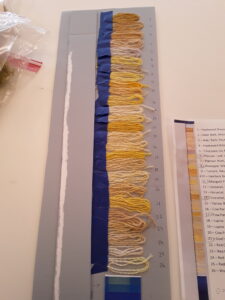
We visited The Alaska State Museum in Juneau, AK in order to study some of the robes in their collection. I wasn’t too sure what to expect when we went, but the experience exceeded my expectations. Ellen Carrlee, the conservator there, first took us to a room where they have been experimenting with different natural dyes. Upon entering the room, we were greeted by a mountain goat who stood rather majestically upon his mounted rock. Seeing the mountain goat was a good reminder of the work and preparation that has to take place way before a weaving is ever started. It was also a reminder of how closely entwined the blankets are to the land here. The weft yarns were in different sections on the table depending on color groups and labeled with what had been used to dye them. The materials used varied greatly. We saw anything from chocolate bar wrappers to copper tubes to lichen wolf mosses, to name just a few of the things. It was fascinating seeing the varying colors.

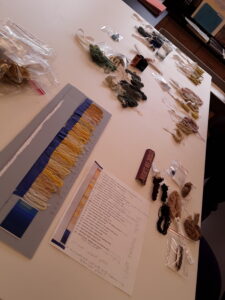
Various samples and tests.
From there we went into another room of the museum’s archives. This was a large room filled with all kinds of artifacts and collectibles of varying kinds: taxidermy, boats, a beaded tunic, an old desk, baskets, and tucked into a corner was where the Chilkat robes are kept. The first robe we studied was laying out on a table ready for us. As we started to look and examine the weaving, I realized that these robes have much to say. That day they reminded me of the weavers of the past and how they continue to teach us to this day. I was seeing hands that created, hearts that designed, and the braids that held so much beauty. I felt the importance of our history dancing and moving about us, encircling our present to move forward with grace into the future.
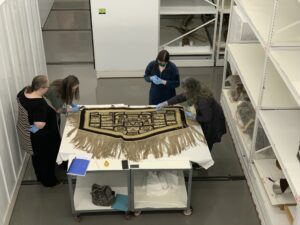
Photo Credit Brian Wallace


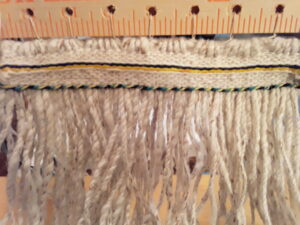
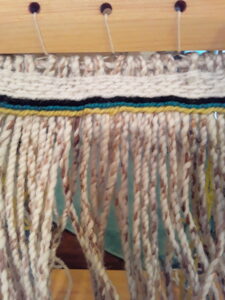
The braids really stood-out to me while at the museum, perhaps this is because I have been learning to braid on my small beginner piece. I remember when I first began the braiding process that it was pretty difficult for me, so Marsha had me do a single braid with three different colored strands. Braids should be one color, but as this is new to me, it was easier to grasp this concept being able to see the three colors coming together in a pattern. Now I am able to create the braids all in a single color.

We measured and examined, talked and pondered. I think my favorite moment was when Ellen asked if we’d like to see the robe the museum had of my Great-Grandma’s, Jennie Thlunaut. An unexpected excitement filled the air. The robe we saw that day was the Kiks.adi robe and is clan owned. It is still taken out and used for special occasions to this day. The vibrant colors of the green and yellow contrasting with the stark black and white kept drawing my eye to it, making it hard to look away. It was filled with circles and some of the most beautifully braided details.
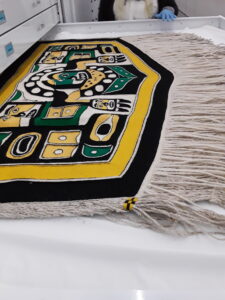

As I looked at the robe before me, I pictured Great-Grandma’s hands moving about and the choices she made to create it. I pictured her hands, that I remember so well, pulling us close in a hug or holding our cheeks as a grandma does. I pictured her hands twining and braiding, adding warps, and taking away. I think she can see us and is pleased.
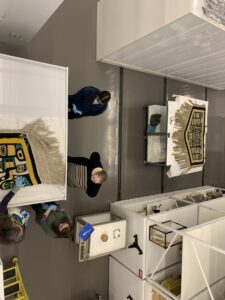
Photo Credit Brian Wallace
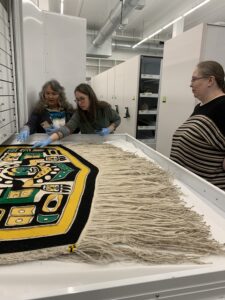
Photo Credit Brian Wallace
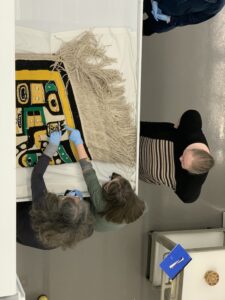
Photo Credit Brian Wallace

Photo Credit Brian Wallace
